
Transport
Infrastructure
Road, rail, and aviation infrastructure connecting Africa's key trade corridors and population centres.
Overview
Transport infrastructure moves economies. Roads connect farms to markets. Railways cut freight costs. Airports open countries to investment. When transport infrastructure is missing, economic growth stalls regardless of the resources available.
KXT invests in and builds transport infrastructure across Africa's key economic corridors: roads, railways, airports, and multimodal logistics hubs. Most transport projects in our pipeline are structured as EPC+F, because governments across our core markets need partners who can bring financing and construction under one contract.
We work directly with government ministries, concession authorities, and development finance institutions to structure projects that reach financial close. That means we are involved in project development from the earliest stages, not brought in at procurement.
Market Opportunity
Africa's transport infrastructure gap costs the continent an estimated 2% of GDP per year in lost productivity, according to the African Development Bank. The total investment shortfall in transport alone is estimated at USD 50 billion annually.
The African Continental Free Trade Area, covering 1.4 billion people and USD 3.4 trillion in combined GDP, will only work if the roads, railways, and ports connecting member states can handle the volumes. Intra-African trade currently accounts for less than 17% of total African trade, compared to 60% in Europe. The physical infrastructure gap is the primary constraint.
Within KXT's core markets, each government has active transport mandates. Nigeria's federal government has committed to rehabilitating 3,000 km of federal roads under its Highway Development and Management Initiative. Kenya is developing expressway concessions and standard gauge railway extensions. Egypt's Vision 2030 includes USD 40 billion in transport investment covering new cities, ring roads, and airport upgrades. South Africa's National Infrastructure Plan prioritises freight rail rehabilitation and major highway concessions.
All of these programmes need private sector finance and EPC partners who understand both the financing and the construction.
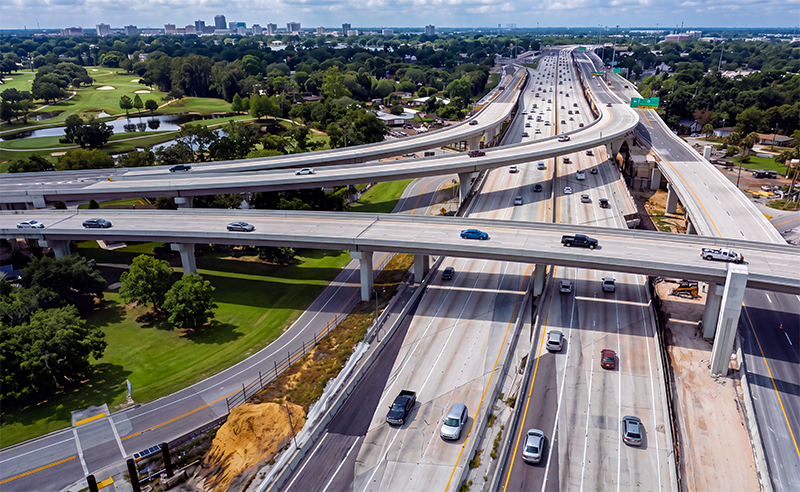
Investment Focus
KXT targets transport projects structured under concession frameworks, toll revenue models, or government viability gap funding. We focus on corridors with documented traffic volumes or committed anchor demand that makes the revenue projections bankable.
Roads and highways are our largest pipeline segment. We target projects with 20 to 30 year concession terms under toll revenue or availability payment structures, where the government counterpart has a track record of honouring concession agreements.
Rail is a growing segment. Bulk freight rail projects backed by offtake agreements from mining or agricultural clients provide strong revenue visibility. Passenger rail concessions in urban corridors offer a second category, with government availability payments underpinning the financial model.
Airport and port infrastructure follows a similar concession logic: long-term user agreements, government backstop, and inflation-linked revenue that protects returns over the investment period.
Development and Execution
Our transport teams manage road, rail, and aviation projects from FEED through commissioning. We apply BIM-integrated design, rigorous project controls, and an established procurement network across our four regional hubs.
For roads, we self-perform earthworks, drainage, pavement, and bridge construction, while managing specialist subcontractors for structures, electrical, and intelligent transport systems. Our project controls function tracks programme, cost, and quality against baseline from day one, using earned value analysis to give clients and lenders early warning of any slippage.
For rail, we work with specialist track, signalling, and rolling stock partners within our PMO structure. Our experience in multi-stakeholder infrastructure programmes means we can coordinate government, regulator, operator, and funder requirements without losing schedule.
Project Examples
- ›Roads, highways & bridges
- ›Railways & high-speed rail
- ›Airports & air route infrastructure
- ›Intermodal logistics hubs
Interested in this sector?
Speak with our team about investment and partnership opportunities.