Africa has 170,000 diesel towers. Tower decarbonization is the continent's most commercial clean energy opportunity.
5 June 2026
Tower decarbonization is not primarily an ESG story. It is a cost story. A single telecom tower in Sub-Saharan Africa can consume 20 litres of diesel per day, at a delivered cost of USD 1.50 to 3.00 per litre depending on market. That is USD 10,000 to 21,000 per tower per year, just in fuel. Replacing diesel with solar hybrid systems and battery storage cuts that cost by 50 to 80%. No ESG mandate is required. The economics do the work.
Africa has more than 170,000 telecom towers. The majority still run predominantly on diesel. Tower operators including IHS Towers, American Tower, and Helios Towers have committed to aggressive decarbonisation targets, driven by cost reduction mandates, ESG reporting obligations to their institutional shareholders, and increasing regulatory pressure across African markets.
IHS Towers, the largest independent tower company in Africa with more than 40,000 towers across ten markets, has committed to reducing its diesel consumption intensity by 60% against a 2019 baseline by 2030. Helios Towers has committed to running the majority of its portfolio on low-carbon energy sources by the early 2030s. These are not aspirational pledges — they are documented programme commitments backed by multi-year capex allocations that need EPC partners capable of executing at volume, at pace, and to a consistent technical standard across diverse geographies.
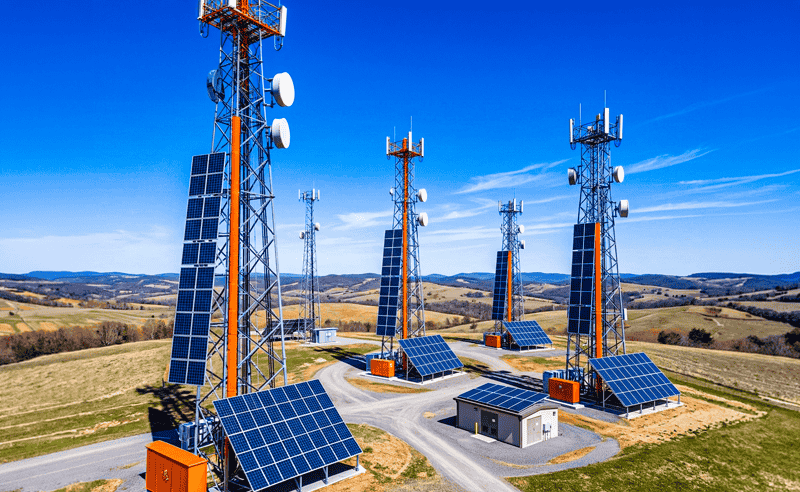
The technology for tower decarbonization is proven and commercially available. A typical conversion involves installing a solar array sized to the tower's daytime load, a battery energy storage system sized for 8 to 12 hours of nighttime load coverage, and a hybrid controller managing the transition between solar, battery, and grid or generator backup. The system reduces fuel consumption by 50 to 80% depending on grid reliability at the site. For off-grid sites with no grid connection, reductions of 80 to 90% are achievable.
The execution challenge is not the technology. It is the logistics. Converting 5,000 or 10,000 tower sites across multiple African countries requires a programme management capability that most EPC contractors in this space do not have. Sites are distributed across urban, peri-urban, and rural geographies. Supply chain for solar panels, batteries, and hybrid controllers must be coordinated across multiple markets. Installation teams must be deployed simultaneously across dozens of sites to meet programme timelines. Quality control must be consistent across the entire portfolio.
KXT has built its telco infrastructure practice around this execution challenge. We deploy programme management teams with regional coordination capability across our hubs in Lagos, Nairobi, Cairo, and Johannesburg. We maintain supply chain relationships with global solar and battery OEMs and in-country logistics providers. We run remote monitoring platforms that track system performance across entire tower portfolios from commissioning, giving operators real-time visibility into energy savings and system health.
The financial model for tower decarbonization has also matured. Early conversions were funded from operator capex budgets. As the scale of the opportunity became clear, structured financing products have emerged. Energy-as-a-service models let tower operators convert sites without upfront capital, paying an energy fee per site per month to the EPC+F developer who owns and operates the solar hybrid system. KXT can structure these arrangements directly, converting operator OPEX into a contracted revenue stream without requiring capital commitment from the client.
5G rollout is creating a parallel opportunity within the same client relationships. 5G networks require significantly denser infrastructure than 4G: more sites, higher power requirements at each location, and fibre fronthaul connecting small cells to the core network. Across KXT's four core markets, 5G rollout is creating a multi-year civil and power works pipeline within the same tower operators and mobile network operators who are commissioning decarbonization programmes.
The intersection of tower decarbonization and 5G rollout means that KXT can offer telco clients a single EPC+F partner for two major infrastructure programmes simultaneously. That consolidation has commercial value for clients: fewer procurement processes, a single accountability structure, and a partner who understands the full scope of their infrastructure requirements.
For investors seeking exposure to Africa's digital infrastructure, tower decarbonisation offers something unusual: a commercial infrastructure story with a clean energy wrapper. The revenue is contracted. The technology is mature. The demand is structural and growing. And the client base, IHS Towers, Helios Towers, American Tower, are publicly listed companies with institutional shareholders who hold them accountable for delivering on decarbonisation commitments. The risk profile is closer to infrastructure finance than venture capital. That combination, commercial returns with measurable environmental impact and investment-grade counterparties, is increasingly rare in emerging market infrastructure.